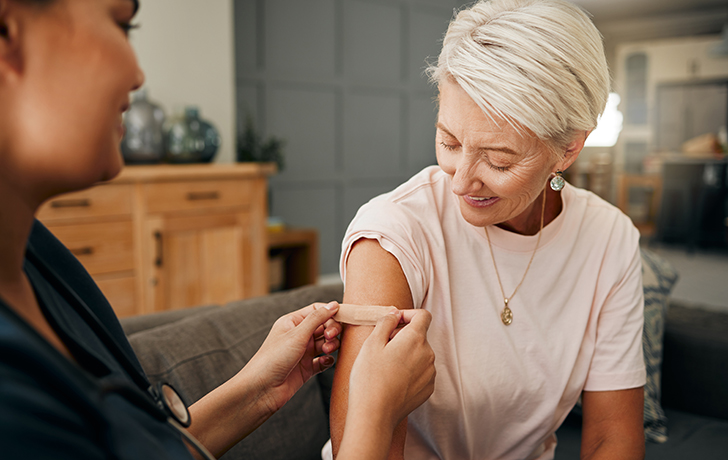
According to a Leger survey conducted earlier this year, Canadians aged 50 and older greatly underestimate their risk of developing shingles. Less than 10%, for instance, knew that 1 in 3 adults aged 50 years and older will develop shingles in their lifetime. Further, by the age of 85 the incidence of developing shingles reaches 1 in 2.
Shingles, also known as herpes zoster (HZ), is a painful and often debilitating condition caused by the reactivation of the varicella zoster virus (VZV), the same virus responsible for chickenpox. Following a chickenpox infection, VZV remains dormant in the nervous system and can reactivate later in life due to a weakened immune system, which can occur as a result of advancing age, health conditions or certain medications.
“Anybody that has had chickenpox, which is well over 90% of people over the age of 50, is at risk,” Explains Dr. Budlovsky, a geriatrician from British Columbia. “Age increases our risk because as we age, our immune system ages with us. Our immune system is like the body’s army, and over time, a lot of these soldiers are just no longer as effective at doing their job. Being immunocompromised or having simultaneous health conditions also increases risk.”
While approximately 1 in 5 respondents of the Leger survey erroneously believe shingles is harmless, just a rash, or has no potential long-term effects, the fact is that shingles can have significant impacts on one’s health.
The symptoms of shingles include a painful, blistering skin rash that can lead to severe complications. In rare cases, complications can include vision loss and scarring. A new Harvard-led study also has found that shingles increases risk of cognitive decline. Shingles pain can significantly disrupt daily life, making it challenging for patients to sleep, work, or engage in regular activities.
“Shingles can be quite serious,” Dr. Budlovsky emphasizes. “For one thing, pain associated with shingles can persist and become chronic. Between 5% and 30% of people who get shingles are unlucky enough to develop postherpetic neuralgia; a burning pain in the nerves and skin that lasts after the rash is gone. Unfortunately, the medications that we use to treat that chronic pain have a lot of potential consequences and serious side effects. So, it’s not just the shingles episode, it’s the shingles and then the complications, and then the treatment of the complications that really spirals.”
Because of the intense pain, shingles is often associated with the use of opioids, benzodiazepines, and other painkillers. Prevention through vaccination can reduce the risk of shingles and may lead to decreased opioid and other pain medication prescriptions1.
Dr. Budlovsky also notes that functional decline can occur with shingles, meaning that the illness can lead to a decrease in the ability to carry out the activities of daily living, potentially impacting independence. “People often feel really unwell with shingles,” he explains, “They feel fatigued and have pain, and don’t want to do much. And if you’re in your 70s or 80s, a week or two in bed is not easy to overcome.”
Finally, Dr. Budlovsky notes that the risk of heart attack and stroke are dramatically higher in the year after you’ve had shingles.
“There’s potentially a lot to an episode of shingles. So, it’s really important to take a step back and say, right, what can we do to prevent us from even talking about this?” People plan on maintaining their health throughout their 70s and 80s, so they can do the things they want to do in their retirement,” says Dr. Budlovsky when emphasizing his deep commitment to preventative healthcare like shingles vaccines,”Things like falls and fractures, or shingles with ongoing nerve pain are the types of things that really knock people off their game plan and begin a cycle of decline. Anything that we can do to prevent that seems like a real no brainer.”
The good news is that vaccination against shingles offers well over 90% efficacy and last for at least 11 years2.
Bill VanGorder, Advocacy and Education Officer for CARP is equally passionate about vaccine awareness. “The World Health Organization (WHO) defines healthy aging as ‘developing and maintaining the functional ability that allows people to be and do what they value.’ Immunization supports healthy aging, and that’s why we advocate so strongly for it.”
CARP encourages members to speak to their health care team about shingles vaccination. While shingles vaccines are available across the country, not all provinces have adhered to the funding recommendation by the National Advisory Committee on Immunization (NACI), which since 2018 has advised that the shingles immunization be offered through public health programs to adults aged 50 and older.
“CARP believes your postal code shouldn’t determine your access to the best available healthcare,” Concludes Bill VanGorder, “And we encourage our members to make some noise about that too. That’s how change happens.”
1GSK Key Values Messaging
2Key Values Messaging