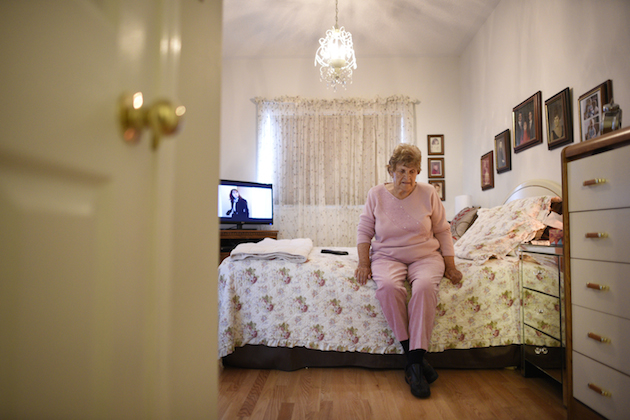
CARP is featuring stories from real members who are experiencing the negative effects of the deficiencies in the key areas that we are promoting during this election period.
Ailing But Proud: Maria Mikelenas-Mcloughlin at 82
“The call came (from Home and Community Care Support Services) at noon. We can’t find a PSW (Personal Support Worker) for you this morning,” Maria Mikelenas-Mcloughlin said to CARP. “I told them, ‘It’s not morning anymore. I’ve been up since 5 o’clock, and this is now the afternoon.” Her voice is filled with exasperation as she continues. “’You know my timetable. I eat breakfast at 6, I have my lunch at 11, and between 4.30 and 5.15, I have my supper because the PSW comes at 6 o’clock.’”
“They said they could maybe get someone in the afternoon. I said, ‘Forget it. I’ve washed my face, with difficulty. I can’t get on my compression stockings because the weak hand from my stroke makes it impossible. But I will make it through the day.”Maria is lucid and brave as she continues. “If you saw my hands, you’d understand what I’m enduring. They’re gnarled and red from the rheumatoid arthritis, and this weather is not very good at all. “
It was icy rain the afternoon when we spoke. Maria Mikelenas-Mcloughlin agreed to talk frankly to CARP, where she feels at home, having been the Etobicoke Chapter Chair before illness caused her to resign. “When I retired, I was on the board for developing an Etobicoke community hub. Our district has one of the highest populations of seniors in the province. I had the senior file for our group because I represented CARP. But my rheumatologist said to me, ‘If you don’t stop doing all your volunteer work, you’re going to collapse. You’re totally inflamed.’”
 This was pre-COVID, and things have gotten more difficult for her in recent years. “There was a machine in North York that my doctor had me go to, and I lit up like a light bulb.” She has been battling arthritis since her forties, with the situation debilitating since 2011 when her husband, Brian, who worked in the public service sector in Ontario, passed away.
Pictured Above: Maria was honoured for her volunteer advocacy with the Etobicoke, ON CARP Chapter. Feb, 2020
“I had to have a hip replacement,” recalls Maria. “And spinal surgery. Both are rheumatoid. They wanted to remove one of my knuckles and put wires in so that I could bend my finger, and at the last moment I said no. Other things started like severe fatigue. It was quite noticeable. Then the pandemic set in, and I ended up breaking my arm.”
For Maria, who met Brian in the public service, and still considers herself a Bill Davis Progressive Conservative “Red Tory,” working for good causes is central to her life. A teacher when she was in her twenties, she is pleased to have worked for Premier Davis and to have spent over a decade at Queen’s Park. As a volunteer activist, she was a natural advocate at CARP and only reluctantly pulled back from being on her chapter’s board.
Telling her story is a way for Maria to continue her good work for seniors. She believes that others should know what medical conditions are like for older adults in Canada. Since Brian’s demise, she is alone and has to cope with loneliness and surviving physically without a partner. Two years ago, she suffered a stroke. Maria remembers: “I couldn’t touch the floor. I thought, I have to go to the bathroom. And I ended up flat on the floor. I put my hand up and I said, ‘Oh my God, they tell you to do that for a stroke.’ And I made sure that I could open my mouth. I slithered on my back to the front door to unlock it and laid down on the floor. I reached for the telephone. In the hallway, I have the landline extension, and I called 911.”
Last November, she had a similar episode, when she collapsed on the floor early one morning. Maria sums it up: “My body was shutting down.” Luckily, a neighbour got worried and called the fire department to break in and save her. At the hospital, she had CAT Scans, X-Rays, and MRIs trying to determine what was happening to her. “What I did primarily was sleep,” she says. “My jaw was out of synch. I was on a catheter for a month. A doctor ordered a transfusion because my blood wasn’t circulating.”
Maria has been back home for a month. She is worried for others because she feels that the medical system needs improvement. “There aren’t standards when it comes to home care. Even though they come and assess you, sometimes you can’t reach them with your concerns. When I had a swollen leg, I tried to reach the coordinator so that she could order a nurse to come and see what was wrong with me, but the communication was lacking. I sometimes wonder about what kind of training the PSWs get, because it’s not the same with all of them.”
Maria Mikelenas-Mcloughlin understands her situation. “Rheumatoid arthritis is an autoimmune disease. You know, there’s no cure. They can put you into some remission, with the biologic needle I give myself once a month. But it’s come and go.” She expects that she will have to sell her house one day and move into a long-term health facility. Wherever she is, she will maintain her pride and activism. “In order to stay relevant,” she says, “we seniors have to advocate for ourselves.”