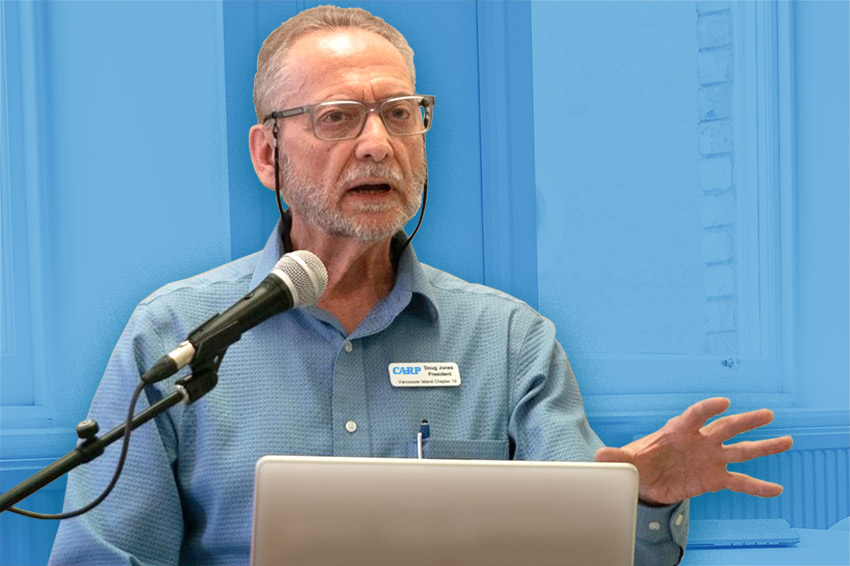
CARP’s Vancouver Island Chapter is led by stalwart advocate Douglas Jones
One of CARP’s most active Chapters in recent years is one of its newest, having restarted in 2022, following several years in hiatus. CARP’s Vancouver Island Chapter represents the far west of BC, covering the entire scenic region, including the Gulf Islands of the Salish Sea. The Chapter is headed by Douglas Jones, its founder, who moved to the district in 2021 after retiring from Western University in London, Ontario, where he had been Vice Dean of the Schulich School of Medicine and Dentistry. Jones, who describes himself as a “giving back” type of person, is a determined and articulate advocate for seniors who leads a group which is similarly stalwart in its defense of older adults.
The Vancouver Island branch recently sent a strongly worded letter to BC’s Health Minister, Josie Osborne demanding free shingles vaccines for all seniors. It echoed one that was sent in December to Premier David Eby from the CARP National Office, writing, “as our population ages, it’s crucial that we take proactive steps to protect the health of our seniors. A comprehensive shingles prevention program would not only improve the quality of life for many older British Columbians but also potentially reduce the burden on our healthcare system.”
Jones believes that “the government should provide FREE the latest approved and recommended COVID-19, pneumococcal (pneumonia), shingles, high-dose flu & respiratory syncytial virus (RSV) vaccines to all seniors.” He notes that Ontario, where he previously lived, offers free shingles vaccinations to seniors aged 65 to 70 as do other provinces and territories for differing age periods, such as the Yukon and Prince Edward Island. Quebec, for example, offers free vaccinations but only to seniors 80 years and over. Recent news headlines have trumpeted the connection between the shingles vaccine and lower dementia risk, which only adds to the case Jones is making. https://med.stanford.edu/news/all-news/2025/03/shingles-vaccination-dementia.html
Jones and his feisty branch have a strong list of issues that they want to see addressed by the provincial government. They include, according to Jones:
- Fast track out-of-province and internationally trained doctors and other health care workers. The lack of healthcare workers is a common problem across Canada, but more acute in BC than in some other provinces. It is particularly problematic for the Vancouver Island Chapter as quite a number of seniors live in remote areas on the islands or in the interior.
- Fund better home care or give better rebates for accessible home adaptations. Make caregiver tax credit refundable. The lack of real cost-of-living adjustments for several years has been identified as a particular issue for seniors living in BC, particularly those who want to be ‘aging at home’.
- Provide provincial funding for medical devices and other equipment to quell higher medical costs down the road. Affordability continues to be a problem for many seniors in BC.
- Provide FREE or additionally reduced TRANSIT FARES for seniors on all transit (not just HandyDART). Transportation issues are a huge concern in many major centres and the situation only gets worse in communities, which are smaller and more isolated.
When it comes to advocacy, it’s important to work closely with people who have access to power. Jones knows this and has created a congenial relationship with those in the office of BC’s Seniors’ Advocate, which in turn works with the provincial leadership. Jones notes that “I had a professional and good relationship to the BC Seniors Advocate since my first contact with Isobel Mackenzie, the previous Advocate. That has continued with Dan Levitt, the current BC Seniors’ Advocate. I have had regular update meetings with them as well as having each of them as speakers at our Vancouver Island Chapter meetings.”
Running the Vancouver Island branch is not without its challenges. It’s a vast and picturesque area, known for its beauty and temperate climate, making it highly attractive to seniors. Recent statistics for the Central Region Area, which includes Victoria, Sidney and the Gulf Islands, states that its 18% share of seniors over 65 is higher than the BC average of 15%, significantly higher than Greater Vancouver’s 13%.” In a rapidly aging province, it is the population growth leader among older adults.
Jones points out that “we have active members throughout quite a vast region. About half live in the Victoria area, and the other half are quite widely distributed throughout the region of Vancouver Island and the Canadian Gulf Island of the Salish Sea. That is one reason that the Chapter relies heavily on providing our monthly newsletter, and ensuring that all Chapter meetings are either exclusively online or are hybrid, with the meeting being recorded and available on YouTube within about a week following every meeting.
“Although we are a very new Chapter, it was also important to have some in-person meetings (workshops) in centres outside of the city of Victoria. For our meetings, we focus on issues affecting members in our region, such as the lack of local physicians and healthcare workers, and the importance of earthquake and tsunami alerts. We book some high-profile speakers, like Dr. Lorna Williams, who spoke on Indigenous issues. Being the ‘new-kid-on-the-block’ it has taken some time to ‘get the word out’ that there is an active CARP chapter in the region and that CARP is a worthwhile organization for seniors and for other seniors’ organizations to consider for collaboration.”
CARP Action asked Jones if there’s one overriding concern that should be addressed. His reply is swift. “I see ageism as being a major issue across North America, as opposed to some other countries that have cultures with more respect for elderly people.” With capable advocates like Jones representing CARP, one can see the country’s level of appreciation for our seniors rising in the future.