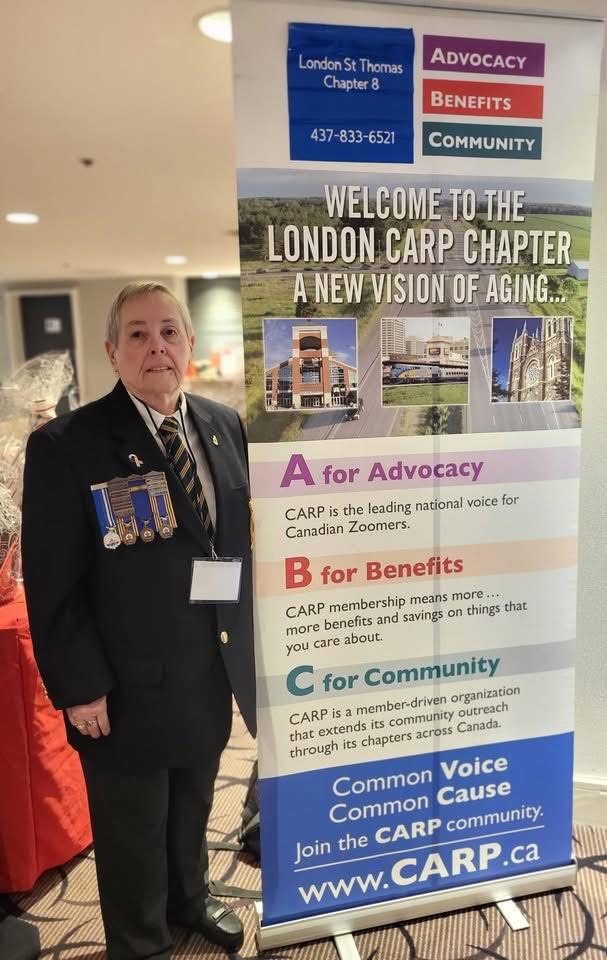
London-St. Thomas CARP Chair Gloria McKibbin fights for seniors’ LTC rights
Gloria McKibbin is more than an articulate spokesperson for Canada’s older adults. She doesn’t just talk the talk; McKibbin has walked the walk. McKibbin spent over 30 years in the nursing and retirement home business in Ontario as an administrator and head of financing. The London-St. Thomas CARP Chair’s criticisms and suggested improvements in the LTC system come from a place of deep knowledge and decades of experience.
“We have to lobby our MPPs for more nursing homes,” she says. “It’s a provincial thing. My MPP lives in my apartment building, right on the main floor. It’s kind of handy. I know him quite well. He’s also a member of the Royal Canadian Legion and so am I, so I can find him there, too.” McKibbin urges her fellow CARP members to emulate her; this is one person who doesn’t mind lobbying politicians to help the cause of seniors.
While McKibbin is kept busy as an advocate for seniors and Chair of the London CARP Chapter, she’s also part of the Legion and many other appropriate organizations, including the National Association of Federal Retirees and the Ontario Long Term Care Association. There are great synergies between the groups, particularly in the service role of the Legion and the advocacy work of CARP, when it comes to meeting the needs of older Canadians.
McKibbin is concerned about the quality of care offered in nursing and retirement facilities in the province. “Too many look and feel like institutions,” she observes, “They should be more like homes.” She was the administrator at the Shelburne Residence Nursing & Retirement Home, a place that had over 100 beds, but emphasized the human touch for its clients. “Everything was personalized. The residents got to pick the color of the walls in their room. If they wanted wallpaper, they could put up wallpaper. They had a real say in their rooms.”
Gloria McKibbin is a believer in maintaining a high quality of life for Ontario’s seniors. For her, it’s the small touches that can improve living in a residence, encouraging a vibrancy in the day-to-day interactions older adults conduct with each other. “In Windsor,” she recalls, about another facility she ran, “we had a residence cat. His name was Shadow, and he always chose to sit in one of my guest chairs in the office.” You can’t legislate having a cat in every LTC but it’s easy to imagine how much a pet can lift up the spirits in a place.
McKibbin works with other CARP Chapters in her advocacy efforts, in particular with Ottawa, which also focuses on LTC issues. One area of concern for her is the amount of money the government allots for seniors. After fixed payments such as rent and food in a regulated facility are taken care of, the older adult gets $149 a month for personal expenditure. “That’s got to cover items like new clothing. If you need to go to the hairdresser, if you need anything personal, that’s all you’ve got. That’s not very much money. We have to advocate to change that.”
McKibbin is candid in her assessment of the (PSW) Personal Support Worker crisis in Ontario. She says, “It was so much better before. When the current government came in, they got rid of a lot of Ministry of Health inspectors. They aren’t doing the annual inspections anymore. That’s why everybody got a little bit lax. And after COVID, a lot of people left.
“Nurses left the business because it was getting too stressful. When the government thought they did a good job by offering free training for anyone who wanted to be a PSW, they didn’t realize that the people they need have to be compassionate. Too many people jump at the offer because they were getting free training.
“I interviewed a guy in Windsor for a PSW job. He had been laid off from the automotive industry after 20 years. I asked him, ‘What made you decide that you wanted to switch into healthcare?’ He replied, ‘I hear you pay good, and I need a job.’ He was honest, but he wasn’t the kind of person to work with seniors.”
She reflects back over her years in nursing and residence home administration in Ontario communities such as Ingersoll, Shelburne, Cambridge, Kitchener and Windsor. McKibbin has many great memories of better days for seniors in LTCs.
“I had wonderful nurses I worked with over the years, and they taught me a lot. I have the utmost respect for not only the nurses, but all the frontline people who give care because it takes a special person to do those jobs. That special person has empathy, and they also have to be effective at important tasks. They have a love for seniors. When I worked in Ingersoll, the girls there were just wonderful. And most of them had been there 25, 30 years. They weren’t going anywhere because they loved what they were doing.
“You can’t provide a two-year training course in five months. Everything is streamlined but the new PSWs aren’t properly prepared to give the care needed for our province, particularly the seniors.”
McKibbin has always had a warm feeling towards seniors and the nursing institution. It started when she was young. “I had a very good relationship with my mother’s parents. We did everything together. Our father owned a business, so he was always getting it up and running and mum worked with them. So, we went on our summer holidays — everything — with our grandparents.”
When she was young, McKibbin recalls, “I had a neighbor down the road, and we were the best of friends. Her mother was a nurse and together we made our plans for the future. We were going to be nurses. Now she actually ended up being a nurse. With me, I was playing baseball and got hit in the head. I had a slight concussion and broken nose. I ended up having epileptic seizures six months later. So, I still am considered an epileptic even though I take medication and have it under control.
“But when I applied for the nursing program, they said at that point in time, I wasn’t totally under control. If I was ever perhaps working with a young baby and went into a seizure, that child’s life would be at risk. So that’s why they wouldn’t admit me to the program. I had to focus somewhere else.”
McKibbin was able to turn her love for seniors and those in need into becoming a gifted administrator. Now, even in retirement, she continues her good work through CARP. It hasn’t been easy for her. Besides the baseball injury, she was involved in a terrible auto crash and several years later was misdiagnosed with a fatal disease, which thankfully was proven to be incorrect. She also had to deal with the unexpected death of her husband at the age of 51. Asked about all of these tragedies, McKibbin is unflappable. “I am a survivor.” That she is — and CARP is benefitting from her wisdom and determination.