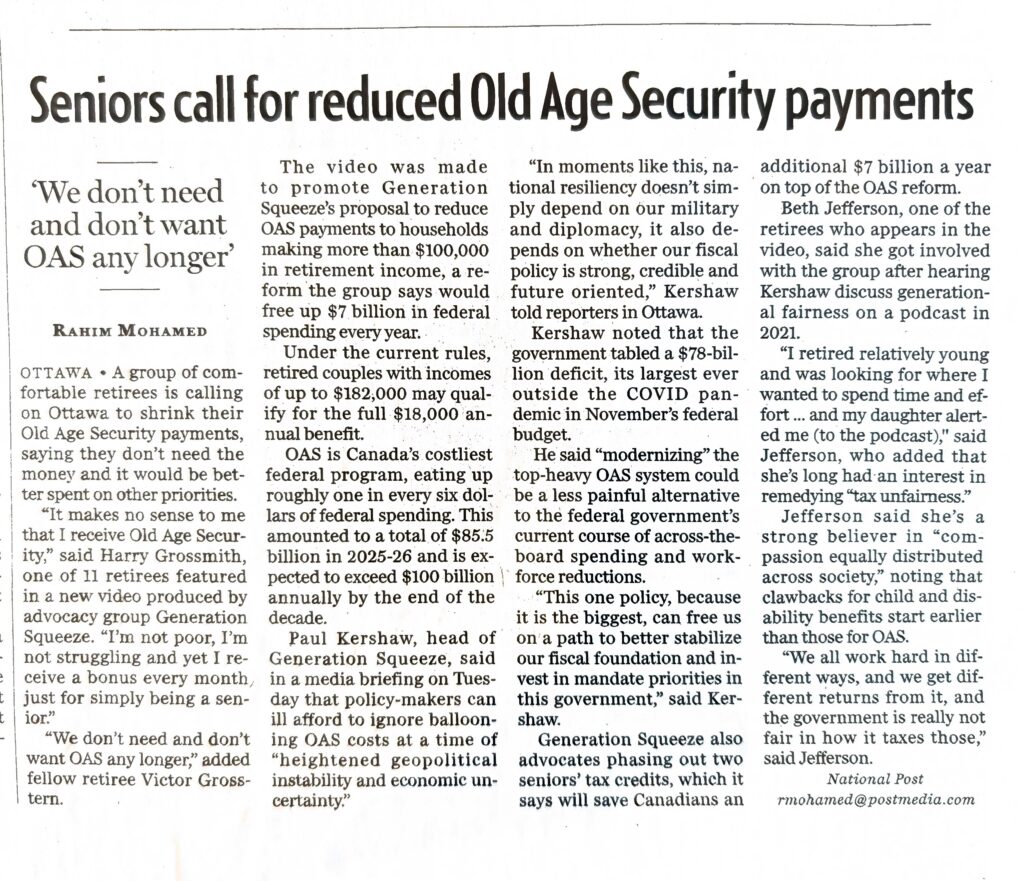
Don’t say we didn’t warn you.
You can see the quote in the headline, “we don’t need and don’t want OAS any longer.”
In my 17 years at CARP, I have only had one member, of many hundreds of thousands over the years, tell us that they don’t want or need OAS. Generation Squeeze has managed to find a handful of others from amongst the over 7 million Canadians over age 65.
Unfortunately, the goodwill of a few generous seniors is being used as political cover for an agenda that would cut Old Age Security for middle-class Canadians who depend on it. But they do not speak for the millions who rely on OAS. CARP warns Canadians not to fall for it
The seniors featured in these stories appear to be acting in good faith. They are financially secure and genuinely believe they do not need their OAS payments. CARP does not question their motives and sees no reason the Canadian government can’t provide them the opportunity to opt out of OAS.
This article features Professor Kershaw from the University of British Columbia, who disguises his true intentions of cutting Old Age Security for average, everyday Canadians, by framing his proposed cuts as just for the “rich” seniors.
His playbook is consistent: reduce a complex national issue to a morality tale in which older Canadians are hoarding resources and younger generations are the victims. He frames OAS cuts as a righteous fight against injustice, and in the fine print acknowledges his real goal of redistributing that portion of the budget into his own pet projects.
Kershaw leans on big aggregate numbers to make OAS sound extravagant, but for individuals it amounts to a maximum of about $740 a month.
In the case of OAS, he argues that Canada could “save billions” by cutting an entitlement that unjustly rewards rich seniors.
But those imagined ‘savings’ don’t come from trimming perks for the wealthy like the generous seniors he features in his social media; they come from reducing benefits for millions of middle-class retirees who spent a lifetime paying taxes and now depend on OAS to keep up with groceries, rent, medications, and heating.
Professor Kershaw’s switcheroo quietly changes how OAS would be calculated. By swapping individual income for household income, he doubles the scale of the cut, proposing drastic clawbacks or eliminating OAS altogether for couples with average earnings of $50,000 each. Meanwhile, the cost of a basic retirement home with meals can easily reach $60,000 a year — double that if care is needed.
Following Kershaw’s plan would punish people who did everything right, paid a lifetime of taxes, saved responsibly, and are still just getting by. The reality is that the number of seniors earning more than $100,000 a year is tiny — estimated to be fewer than four percent. And only a fraction of those make more than $150,000.
In fact, Paul Kershaw has a number of terrible policy ideas: He is an advocate for home equity taxes, and has framed seniors as a key driver of healthcare and housing pressures, all of which shift blame from policy failure to older Canadians.
As for that small percentage of truly wealthy retirees with millions in liquid assets, who manipulate their declared income to collect OAS — they’re on their own. The average senior would agree with closing such loopholes. But that’s a far cry from gutting a program that keeps millions of older Canadians above water.
CARP does not deny that younger Canadians face serious economic pressures. Housing, childcare, and affordability matter. What we reject is the false choice Kershaw presents, that the only way forward is to take from seniors who did everything right and give to his preferred policy priorities. No one cares more for younger Canadians than their parents or grandparents. But Kershaw’s ‘Robin-Hood’ plan to take from seniors and give to the youth completely misses the mark.
That is why CARP is pushing back, and we need you to join that fight.
Anthony Quinn, CARP President.

The above article appeared in the National Post, February 4, 2026