Re: Ontario Ministry of Health Media Release April 1, 2026:
“We Won’t Get Fooled Again” was a teenage anthem as early as 1971 and for decades after that. But it seems that the province of Ontario is hoping that aging baby-boomers, the oldest turning 80 this year, might have forgotten the chorus.
I can assure you they have not.
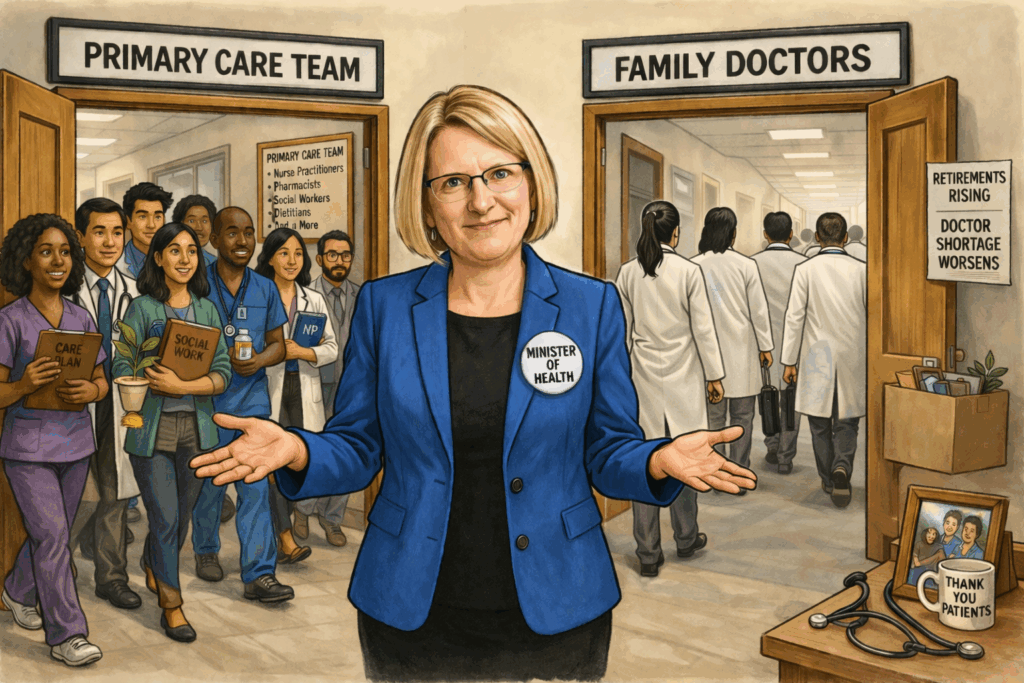
The government is promising that every Ontarian will be connected to primary care by 2029. It sounds like real progress after years of doctor shortages, emergency room overcrowding, seniors languishing undignified in hospital hallways and long waits for specialists and diagnostic tests. But the re-wording reveals a quiet shift that should worry patients, especially seniors.
The province no longer promises to attach everyone to a family doctor. Instead, it talks about “primary care.” That term now covers a wide range of services, from nurse practitioners to pharmacists, social workers, dieticians, chiropodists and lactation consultants.
The government points to solid numbers. It has already attached roughly 330,000 people to ongoing primary care in 2025-26, ahead of its initial target. Yet more than 2.5 million Ontarians still do not have a family physician, according to the Ontario Medical Association, and over half of family doctors say they are considering reducing their workload or retiring in the next five years.
This is a cynical redefinition of success that quietly lowers the bar for patients.
A family doctor is not just another provider. Family doctors undergo years of rigorous medical training that equips them to diagnose complex conditions, interpret subtle symptoms, and make critical decisions that other providers simply are not trained to handle at the same depth. Most importantly, a family doctor tracks your health over years and sometimes decades. For seniors juggling multiple chronic conditions, this long-term continuity is essential.
“Primary care,” as the government now uses it, introduces a false equivalence between a family doctor and an occupational therapist or a social worker. These complementary services have real value in their place, but they are no substitute for a dedicated physician who truly owns your care over the long haul.
Typical of political spin, this broad “primary care attachment” target has made it far easier to declare victory without solving the real crisis: the severe shortage of family physicians.
CARP supports expanding team-based care and giving nurse practitioners and pharmacists a bigger role. The system desperately needs every capable provider on deck, especially with retirements looming and an aging population driving demand higher. But these roles must support family doctors, not replace them.
Ontarians deserve the truth.
When the government promises “primary care for all” by 2029, does that actually mean a family doctor for those who need one?
Health Minister Sylvia Jones must publicly report the true number of Ontarians who have a family doctor, not the inflated “attachment” figures. She should clearly define what counts as “attachment.” And her Ministry must measure and report real outcomes: fewer emergency visits and fewer hospital readmissions for starters.
Ontario faces tough realities: a global doctor shortage, rising demand, and the difficulty of training and retaining physicians. Investments in recruitment and reduced paperwork are welcome, but rebranding the problem and lowering the standard is not leadership.
For generations, access to health care in Ontario has meant one clear thing: having your own family doctor, someone who knows you, follows your health year after year, and takes real responsibility when it matters most. That standard must not be tossed aside for a looser, weaker model.
If the government truly believes this broader primary care network is the future, then it owes every Ontarian a blunt, honest explanation of exactly what patients are losing in this shift.
Seniors and their families cannot afford this sleight-of-hand. The 2029 promise must mean real care, not a diluted substitute.
The government needs to drop the spin and deliver the family doctors that Ontarians were promised.
Anthony Quinn
President
CARP