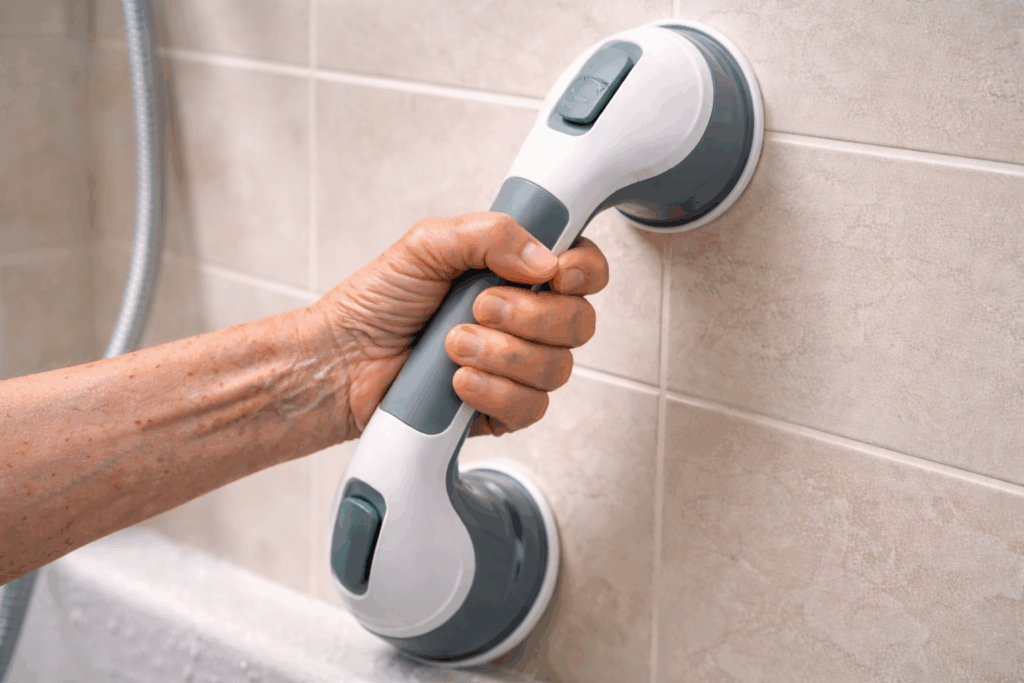
Why suction grab bars may be putting seniors at risk
There is a simple truth when it comes to preventing falls: what looks like support must actually be able to support you.
Across Canada, more older adults are taking steps to make their homes safer. That is a good thing. Properly installed grab bars, especially in bathrooms, are one of the most effective ways to reduce falls and maintain independence.
But there is a growing concern that needs attention.
Temporary suction grab bars, commonly sold in pharmacies and home health sections, are not designed to hold your weight.
Most suction grab bars clearly state they are intended for balance or stability only, not for full body-weight support. In other words, they are not designed to help you if you begin to fall. At the exact moment you need support the most, they may not be able to provide it.
This creates a serious and predictable problem.
Older adults do not buy grab bars for light balance. They buy them for safety and to prevent falls. And when a product is placed on a shelf in a pharmacy or mobility section, the assumption is that it is suitable for that purpose.
That assumption is not always correct.
Dr. Nancy Edwards and a dedicated group of volunteers through CARP’s Ottawa chapter are leading the charge on fall prevention in Canada. Their work continues to reinforce a simple but critical point: safety devices must perform when they are needed most. Research and advocacy in falls prevention have consistently shown that effective fall prevention depends on properly installed, load-bearing supports. Devices that are not securely fixed, or that can fail under load, do not provide the level of protection people believe they do. In some cases, they can increase risk by creating a false sense of security.
Suction grab bars rely on surface conditions, proper installation each time they are used, and ongoing monitoring. They can loosen without warning. They are not engineered to withstand the sudden force of a slip or fall. That is why manufacturers include clear warnings.
Yet in practice, those warnings are easy to miss—and they are often outweighed by how the product is presented.
When suction grab bars are sold alongside mobility aids, or in environments focused on senior health, they can appear to be a safe, reliable solution. For many Canadians, that is all the reassurance they need.
CARP believes that it is not good enough.
We have begun contacting vendors and retailers across Canada to ask that these products not be placed on shelves alongside mobility supports in a way that suggests they are appropriate for fall prevention. The risk of misunderstanding is too high, and the consequences are too serious.
There may be limited situations where suction grab bars have a role. For example, when travelling, where permanent installation is not possible, or for very light, temporary balance support following a minor injury. Even in those cases, they should be used with caution and with a clear understanding of their limitations.
But for ongoing safety at home, they are not the solution that many people believe they are.
If you are relying on a grab bar to prevent a fall, it needs to be securely installed and designed to support your weight.
Anything less carries risk.
Join the fight for safer standards
CARP is advocating for clearer standards and safer retail practices across Canada.
If you see suction grab bars being marketed or positioned as mobility or fall-prevention aids, we encourage you to speak up.
Contact your local pharmacy. Ask questions. Make it clear that safety matters.
This is a simple change that can prevent serious injuries.
CARP will continue to push for practical, common-sense improvements that help Canadians age safely, confidently, and with dignity.
For more information on fall prevention, Parachute Canada has a number of great resources, including the new “Caregivers’ Guide to Fall Prevention“