Join the Fight!
The Old Age Security (OAS) program is one of the cornerstones of Canada’s social safety net. First introduced in 1952, the OAS program was designed to ensure that no senior would face old age in poverty. But decades later, CARP members are telling us loud and clear: OAS is not keeping up. Rising costs-of-living, growing income disparity, and outdated policies demonstrate that Canada is failing its seniors. Especially in the face of billions of dollars in government deficits and tariff threats from the south, OAS now has the biggest target on its back. It is the first place the government will look for savings—threatening Canadian seniors’ ability to live with dignity in retirement.
We’ve been warning this was coming.
CARP has been sounding the alarm for years about the growing movement to undermine Old Age Security (OAS) — and we were called alarmists.
Well, wake up everyone! The alarm is ringing.
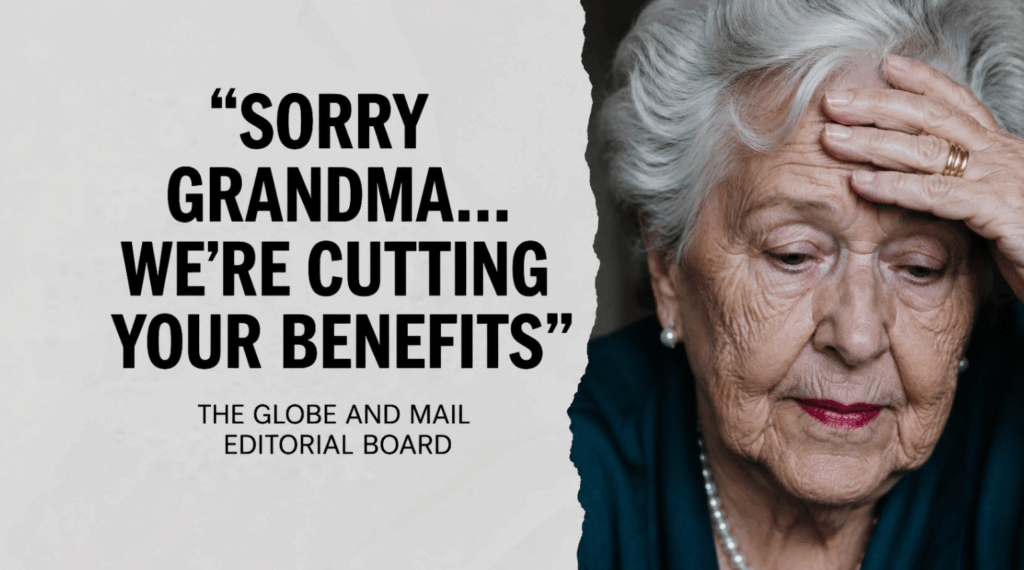
Dr. Paul Kershaw and his organization, Generation Squeeze, are pushing for cuts to OAS, claiming it’s “unfair” to younger Canadians. The Globe and Mail gives him regular columns where he promotes generational warfare — and the editorial board and columnists join the chorus, repeating the same talking points about “wealthy seniors” and “handouts.”
This is an attack on every middle-class senior in Canada.
The Truth
Old Age Security is a lifeline, not a luxury.
It keeps millions of older Canadians above water in a time of rising costs, inflation, and shrinking support systems.
It’s not the rich who depend on OAS; it’s ordinary people — retired labourers and daycare workers, small-business owners, tradespeople, and truckers — who worked hard all their lives, paid their taxes, and contributed to this country in every way.
What They Don’t Tell You
OAS clawbacks are based on pre-tax income — not on what seniors actually take home.
A retiree earning about $91,000 before tax might bring home closer to $60,000 after deductions, yet that’s when Ottawa starts clawing back their OAS.
The vast majority of Canadian seniors are not living in luxury — they’re paying rent, helping adult children and grandkids, covering drug costs, and trying to keep up with record inflation.
Only about 6% of Canadian seniors earn over $100,000, and barely 2% make more than $150,000.
Yet Dr. Kershaw wants to rebuild the entire OAS system around that tiny fraction — punishing that middle class group of seniors who are anything but wealthy.
The Numbers That Matter
Older Canadians are not a burden — they are the fiscal backbone of this country.
-
Seniors pay roughly $70 billion a year in income taxes, more than 20% of the national total.
-
They pay about 40% of all property taxes.
-
They contribute billions more in GST/HST every year through daily spending.
In total, Canadians 65+ contribute over $100 billion annually in taxes, yet they are framed as lazy, greedy, and entitled.
A Message for Ottawa
Prime Minister Mark Carney is an economist. He knows numbers.
And CARP is urging him not to fall for Dr. Kershaw’s bad math and generational resentment.
You don’t “help” younger Canadians by dismantling the social contract that built this country.
OAS has already reduced seniors’ poverty from 40% to under 6%.
Undoing it now, under the false banner of “inter-generational fairness,” would erase one of Canada’s greatest social successes.
This isn’t about fairness — it’s about cutting billions from seniors to bankroll Dr. Paul Kershaw’s pet projects.
He says his plan would “help younger Canadians,” but that’s the sales pitch, not the motive. His campaign, funded by government-backed institutions like the University of British Columbia and the Canada Mortgage and Housing Corporation, isn’t about intergenerational equity. It’s about redirecting seniors’ benefits into social programs that fit his own ideological agenda.
Kershaw’s brand of “fairness” means taking from those who built the country and redistributing it to fund experiments that serve his policy wish list. He calls it balance. We call it betrayal.
CARP will not let that happen. We will continue to expose this false narrative, defend Old Age Security, and stand up for the Canadians who worked a lifetime to earn it — because OAS is not a handout, it’s a promise.
We’ve Been Here Before
We’ve fought and won before:
-
We reversed the OAS age hike.
-
We secured pension income splitting.
-
We ended mandatory retirement.
And we’ll fight again — because this is about respect, fairness, and keeping the promise Canada made to every working person: that after a lifetime of contribution, you won’t be left behind.
Why It Matters: CARP Sounds the Alarm on Senior Financial Insecurity
OAS is a lifeline—especially for low-income seniors. For many, it makes up nearly half or more of their annual income. Without it, tens of thousands would be living in poverty.
Historically, workplace pension plans helped bridge the income gap by offering a reliable, lifetime income. However, those days are gone. A 2020 National Institute on Ageing report shows that approximately 12 million working Canadians are heading toward retirement without a workplace pension. These individuals have median savings of only $3,000. Many seniors are finding that their personal savings have not kept pace with the rising cost of living, making it increasingly difficult to meet ongoing needs. That’s not financial planning—that’s a national crisis.
Canada saw dramatic reductions in senior poverty from the 1970s through the mid-1990s, thanks in part to OAS and the Guaranteed Income Supplement (GIS). But that progress is under threat. Today’s seniors are being squeezed by the soaring costs of housing, healthcare, and groceries. OAS must be strengthened—not merely maintained—to prevent a resurgence in seniors’ poverty.
The Issue: Rising Costs, Shrinking Support
CARP is hearing from members across the country: OAS is no longer enough. Inflation and a sharply rising cost of living have made that painfully clear.
Even with OAS and GIS, some seniors still experience financial insecurity. According to the Material Deprivation Index, one in five Canadians aged 50 and older lives at or near poverty levels. That is unacceptable. Senior poverty rates have been rising: from 3.1% in 2020 to 5.6% in 2021 and 9.9% in 2022. Women, immigrants, and single seniors are hit the hardest. For example, 16.9% of women aged 65 and older live in poverty.
There is also growing political pressure to cut or restrict OAS to help balance government budgets or shift resources to younger generations. CARP rejects the framing of this issue as a generational trade-off. Pitting seniors against youth is a zero-sum game in which nobody wins.
Claims that OAS is unaffordable are simply false. The Parliamentary Budget Officer has confirmed that the program is sustainable over the long term without the need to raise taxes. Any cut to OAS would be a political choice—not a fiscal necessity.
To make matters worse, the government relies on outdated poverty measures that fail to reflect seniors’ real costs. Canada’s official poverty line, the Market Basket Measure, does not account for the unique financial pressures faced by older adults, including high prescription costs, mobility aids, and long-term care expenses. The result is a poverty measurement that grossly underestimates the true extent of hardship among seniors.
Current Status: CARP Calls Out Gaps in OAS Policy
As of 2025, the OAS program continues to provide monthly payments to eligible seniors. The payment amount is adjusted quarterly to reflect changes in the Consumer Price Index. Individuals aged 65 to 74 with a net world income between $93,454 and $151,668 are subject to the OAS pension repayment, commonly known as the “clawback.” For those aged 75 and older, the upper threshold is $157,490. OAS eligibility is based on years of residency in Canada, not employment history. Additional benefits for low-income seniors include the GIS, the Allowance (for spouses aged 60–64), and the Allowance for the Survivor.
However, in July 2022, the federal government introduced a 10% OAS increase—but only for those aged 75 and older. CARP believes this is discriminatory and out of touch with economic reality. All seniors, regardless of age, face the same inflation, rising healthcare costs, and housing challenges. Support should not start at age 75. Inflation doesn’t wait—and neither should support.
In February 2025, the government announced a one-time $400 enhancement to OAS and CPP. While welcome, this falls far short of a long-term solution. In 2024, the Bloc Québécois introduced Bill C-319 to amend the Old Age Security Act and increase OAS payments by 10% for all pensioners aged 65 and older—an approach CARP supports.
CARP’s Demands
More than 250,000 CARP members across the country agree that OAS is the lifeline of their retirement. CARP remains vigilant in protecting OAS from cuts, clawbacks, or eligibility changes. We are committed to strengthening OAS as a central pillar of Canada’s social safety net.
CARP demands the following:
-
Develop a senior-specific poverty measurement that reflects the true costs of aging—including healthcare, housing, and caregiving.
-
Keep current OAS thresholds intact. Reducing access would widen economic disparities and harm those without private pensions or significant savings.
-
End the discriminatory practice of limiting OAS increases to seniors aged 75 and over. Canadians aged 65 to 74 face the same financial pressures. Age-based inequality has no place in a universal pension system.
Conclusion
OAS is more than a monthly cheque. It’s a promise—a promise that Canada will protect its older adults from poverty and neglect. CARP is demanding that this promise be kept.
While OAS has successfully helped reduce poverty among seniors for decades, today’s rising living costs, inflation, and the decline in workplace pensions are placing that success at risk. CARP will continue to fight for a stronger, more inclusive OAS program that supports all older Canadians.