
After CARP urged Prince Edward Island Premier Rob Lantz to make health care and population aging a priority, Canada’s Premiers called for a stronger federal funding partnership—and PM directed health and finance ministers to begin work on the system’s long-term funding.
CARP went to Charlottetown with a clear message for Canada’s Premiers: the crisis in health care—and the growing needs of an aging population—could not be pushed to the side any longer.
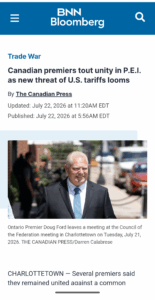
The annual Council of the Federation Summer Meeting brought together all 13 provincial and territorial Premiers in Prince Edward Island from July 21 to 23. They arrived with no shortage of urgent concerns, including affordability, economic growth, internal trade, public safety and the latest tariff pressures from the United States.
President Donald Trump’s administration had announced additional tariff measures affecting Canadian goods just as the Premiers were gathering. Nevertheless, CARP believed that the daily health care experiences of Canadians—overcrowded emergency departments, lengthy waits, difficulty finding primary care and inadequate support at home—also demanded national attention.
(CARP Advocacy front and centre, Atlantic Canada news coverage during the meeting in Charlottetown)
CARP asked for health care to be put on the agenda
Before the meeting, CARP wrote to Premier Rob Lantz, who was serving as Chair of the Council of the Federation and host Premier, asking him to make health care, population aging and federal-provincial-territorial cooperation central items on the Premiers’ agenda.
Our message was straightforward: Canada has studied its health care problems repeatedly. Governments know where the pressure points are. Patients, families, caregivers and health professionals experience the consequences every day.
What has been missing is sustained cooperation across governments, adequate long-term funding, clear responsibilities and measurable progress.
CARP was therefore delighted to see health care emerge as one of the central priorities in the Premiers’ final communiqué—even as Canada-U.S. relations and tariffs were taking up enormous political attention. The Premiers devoted the first major policy section of their communiqué to health care and described rising costs and expenditure pressures that are outpacing provincial and territorial revenue growth.
of Charlottetown healthcare discussions. Click to read.
Premiers call for a stronger federal funding partnership
The Premiers’ health care statement included several encouraging commitments for CARP members.
They warned that important federal health funding agreements will begin expiring as early as March 2027, creating what they described as a looming fiscal cliff. They called on the federal government to renew those agreements, become a full funding partner and provide the certainty provinces and territories need to plan and deliver care.
The Premiers also called for the Canada Health Transfer to continue growing by at least five per cent annually after March 31, 2028. Within the next two years, they want a long-term federal commitment to flexible and sustainable funding that reflects provincial and territorial health care priorities.
That funding supports services of particular importance to older Canadians, including primary care, home and community care, long-term care, mental health services, medications and support for health professionals.
CARP has consistently argued that provinces and territories cannot be expected to meet growing health care demands without a reliable federal partner. Provincial governments deliver most care, but the financial and demographic pressures facing the system are national in scale.
As we told the Premiers: There is only one taxpayer, and that taxpayer expects governments to work together.
Health and finance ministers have now been given the job
A further positive development came when Prime Minister Mark Carney joined the Premiers for the First Ministers’ Meeting on July 23.
Their joint statement confirmed that health care had been discussed and that First Ministers would direct their health and finance ministers to examine longer-term funding and productivity in the sector.
The direction now places responsibility with federal, provincial and territorial health and finance ministers. At the federal level, that includes Finance Minister François-Philippe Champagne working with his provincial and territorial counterparts.
This is not yet a final funding agreement, a cheque or a complete reform plan. But it establishes a formal path for governments to confront the financial requirements of a universal health care system worthy of our country—and worthy of what Canadian taxpayers already contribute to support it.
CARP will be watching closely for timelines, meetings and measurable results.
CARP brought members’ concerns directly to political leaders
CARP attended the Charlottetown meetings because older Canadians deserve to be represented where national priorities are being discussed.

CARP’s Anthony Quinn (right)
We used the gathering to speak directly with political leaders and senior government officials about the pressures facing older adults, patients, caregivers and families. We left Charlottetown with new contacts and important follow-up work to complete. CARP’s internal review concluded that our presence was worthwhile, but also recognized that the real value of the visit will depend on turning that access into meetings, commitments and continuing action.
Our purpose was to make sure that population aging was understood as a central consideration in health care planning—not as an issue that can be postponed until some later date.
The demographic timetable will not wait. The oldest members of Canada’s baby-boom generation turn 80 this year. That reality will bring growing demand for primary care, diagnostics, hospital care, home support, long-term care and assistance for family caregivers.
CARP members have already made their priorities clear. In our April 2026 national poll of 7,883 respondents:
- More than 83 percent strongly agreed that improving access to primary care must be a top priority.
- Nearly 80 percent strongly supported reducing waits for specialists, diagnostic imaging and medical procedures.
- More than 75 percent strongly agreed that long-term care must be prioritized.
These numbers reflect the experiences of people unable to find a family doctor, waiting in pain for surgery, spending long hours in emergency departments or struggling to secure enough support to care for a loved one safely at home.
A welcome step—but now governments must deliver
CARP welcomes the commitments made in Charlottetown.
The Premiers put health care prominently on their agenda. They called for the federal government to become a stronger and more dependable funding partner. And First Ministers gave health and finance ministers a clear assignment to discuss the system’s long-term funding and productivity.
Those are positive developments for CARP members and for every Canadian who depends upon universal health care.
But communiqués must now lead to action.

CARP President, Anthony Quinn (left)
CARP will continue pressing governments to renew expiring agreements, establish sustainable funding, improve access to primary care, reduce unacceptable waits, strengthen the health workforce and invest substantially in home, community and long-term care.
Governments must also agree on transparent goals and public reporting so Canadians can see whether new funding is improving access and patient outcomes.
Canada’s universal health care system is one of our country’s defining commitments. Maintaining it will require political cooperation, financial realism and the willingness to plan for the population Canada has become.
Charlottetown was an encouraging beginning. CARP will work to make sure it is followed by action.